
The 2024 Annual Work Trend Index makes it clear that AI in action is already transforming the world of work at a dizzying pace. Alongside these technological innovations, however, significant challenges are emerging that we need to address. This article explores how artificial intelligence is redefining the world of work and the challenges we face in integrating these technologies effectively and safely.
AI is already transforming the workplace in surprising ways.
Today, 75% of knowledge workers use AI in their day-to-day work, and 46% of them started doing so less than six months ago. The results speak for themselves: 90% say AI saves them time, 85% highlight that it lets them focus on more important tasks, 84% feel more creative and 83% enjoy their work more. For example, the most frequent Teams users (the top 5%) summarized 8 hours of meetings with Copilot in March, the equivalent of a full working day.
"We are at the forefront of integrating AI not just to work faster, but to work smarter. It is our responsibility as organizational leaders to ensure this technology elevates our teams' creativity and aligns with our ethical values."
—Karim R. Lakhani, Chair of the Digital Data Design Institute at Harvard, and Dorothy & Michael Hintze Professor of Business Administration at Harvard Business School
Although most leaders recognize that AI is essential, the pressure to demonstrate an immediate return on investment is making them take things more slowly. 79% agree that their company needs to adopt AI to stay competitive, but 59% worry about how to measure AI productivity gains. That uncertainty is holding back the vision: 60% of leaders are concerned that their organization's leadership lacks a clear plan for implementing AI.
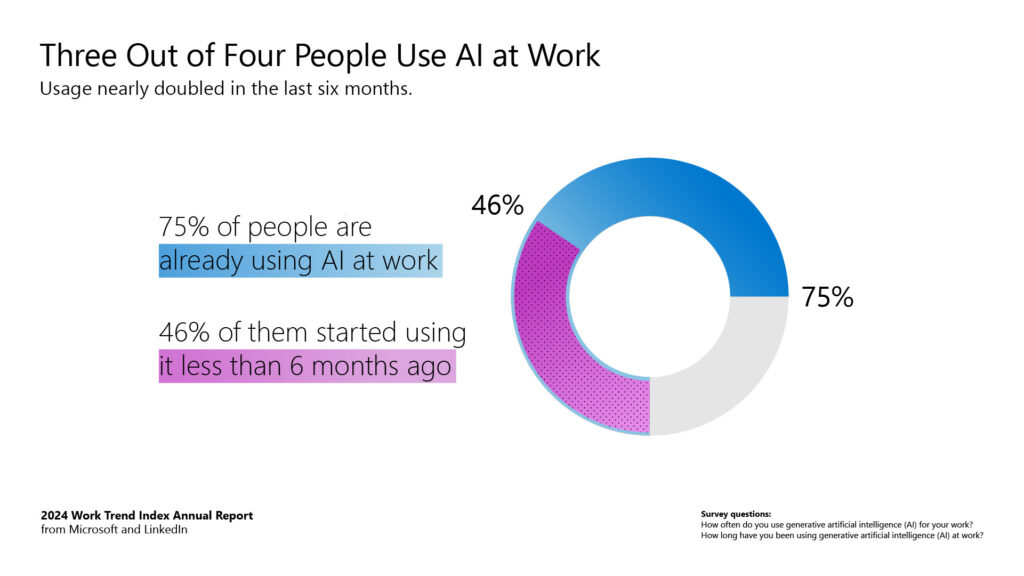
Survey questions
How often do you use generative artificial intelligence (AI) for your work?
How long have you been using generative artificial intelligence (AI) at work?
Without support from senior leadership, employees are taking the initiative with AI in secret.
78% of AI users bring their own AI tools to work (BYOAI), and this is even more common at small and midsize companies (80%). And it is not just a Generation Z thing: BYOAI happens across every generation. 52% of people who use AI at work are reluctant to admit they use it for their most important tasks. 53% worry that using AI on important work tasks could make them look replaceable. This approach means we lose the benefits of strategic AI use at scale and puts company data at risk, especially when leaders' biggest concern for the coming year is cybersecurity and data privacy.
What does BYOAI mean?
BYOAI stands for "Bring Your Own AI", a term that refers to the practice of employees bringing their own artificial intelligence tools into the workplace.
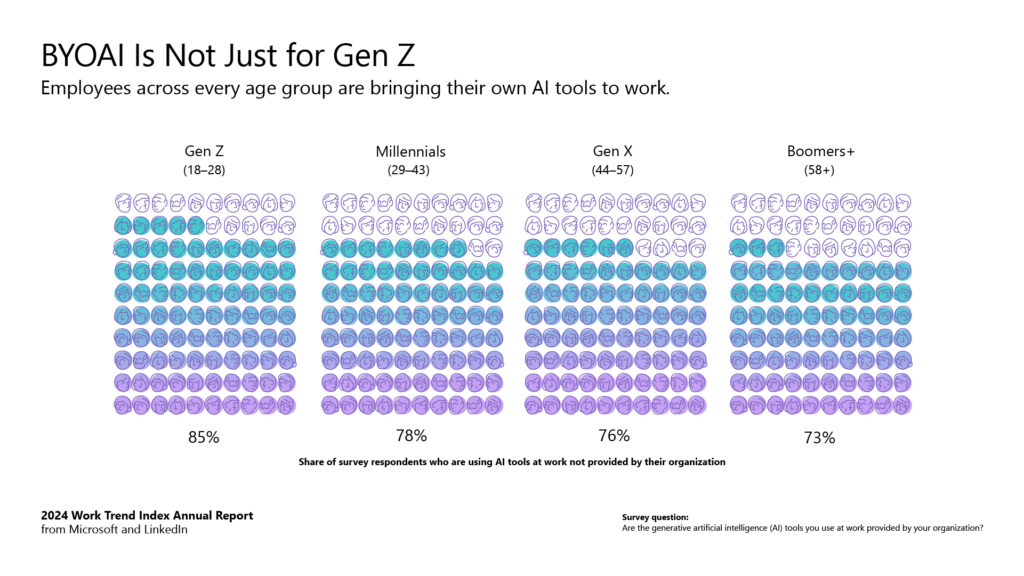
Survey questions
Are the generative artificial intelligence (AI) tools you use at work provided by your organization?
Another factor driving BYOAI is that work has accelerated faster than employees can keep up with. 68% say they struggle with the pace and volume of work, and 46% feel burned out. Email overload remains a problem: 85% of emails are read in less than 15 seconds, and the average person has to read about 4 emails for every 1 they send.
On top of that, meetings and after-hours work have stayed at their post-pandemic highs, and the workday is still tilted toward communication: in Microsoft 365 apps, users spend 60% of their time on email, chat and meetings, and only 40% in creation apps like Word and PowerPoint.
AI is revolutionizing the workplace.
As AI becomes more embedded in our lives, leaders who are "very familiar" with it see its potential as being as transformative as the shift from the typewriter to the computer. Over the next five years, 41% of these leaders plan to redesign business processes from the ground up with AI. They also anticipate orchestrating (38%) and training a team of AI bots (42%), and ensuring that ethical AI use (47%) is central to their work.
The data is clear: people are overwhelmed by digital debt and work pressure, and they are turning to AI for relief. The opportunity for every leader is to channel that momentum into a return on investment.
Adopting AI is not just about integrating new technology tools; it is about redesigning processes, fostering a culture of innovation and making sure AI is used ethically and responsibly. Leaders who manage to navigate these challenges and capitalize on the opportunities AI offers will be better prepared for the future. It is a path full of potential, but it requires vision, strategy and, above all, the willingness to adapt to change.