
The new phase of industrial cybersecurity marks a turning point for every organization that operates critical infrastructure. Today, industrial environments face constant pressure from a rise in attacks that are faster, more sophisticated and harder to prevent. This affects far more than IT systems: it also puts operational continuity, people's safety and the stability of key sectors such as energy, manufacturing, transportation and construction at risk.
What follows is a clear analysis of this new scenario, based on the recent trends that are transforming industrial security.
An increasingly vulnerable industrial environment
Sustained growth in attacks
Recent data shows that a significant share of industrial systems remains under constant threat. Although the percentages vary from one quarter to the next, the trend holds: a substantial proportion of equipment is the target of attack attempts on a recurring basis.
This makes it clear that incidents are no longer isolated events. Organizations that depend on automated processes or interconnected systems live in a state of permanent exposure.
Direct impact on operations
A single attack can cause production stoppages, delays across the supply chain or considerable financial losses. It also compromises the safety of facilities that often operate in remote areas, or with equipment that was never designed to face modern threats.
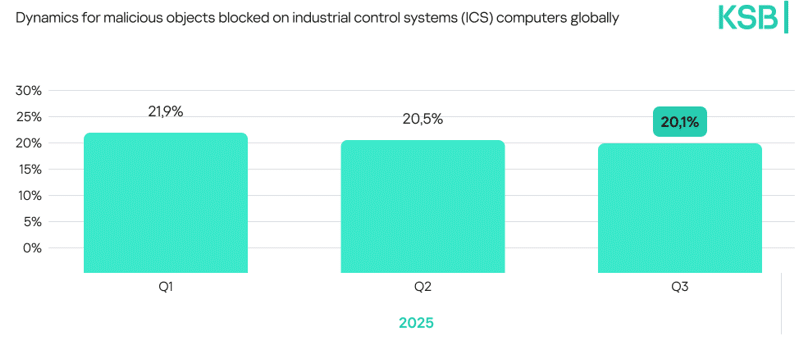
Global trend in blocked threat attempts on industrial control system (ICS) computers
How attack methods have changed
Exploiting trust relationships
Cybercriminals no longer focus solely on technical vulnerabilities. They now look for a way in through suppliers, partners or external services that are part of the supply chain.
An incident at a single supplier can affect dozens of companies at the same time, amplifying the consequences.
The most exposed sectors
Some sectors show a higher level of risk because of the type of systems they use. Among the most affected are:
- Biometric systems
- Building automation
- The electric power sector
- OT engineering and integration
- Construction
- Manufacturing
- Oil and gas
Although the percentages vary, they all share the same behavior: the pressure is constant and growing.
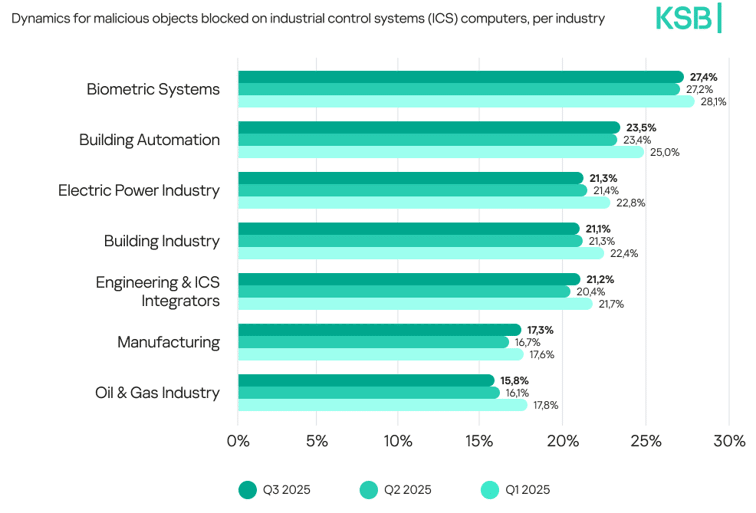
Trend by industry in blocked threat attempts on industrial control system (ICS) computers
The role of artificial intelligence in attacks
Faster, more adaptable threats
One of the most significant shifts is the use of artificial intelligence by attackers. Over the past year, there has been an increase in automated operations capable of:
- Making decisions without human intervention
- Adapting to their environment on their own
- Moving quickly inside industrial networks
This shortens the window of time available to detect and stop incidents, forcing security teams to respond with greater speed and precision.
The exposure of internet-connected systems
Remote facilities: a critical point
Many industrial plants, transportation systems and energy facilities are more connected than ever. That connectivity, however, does not always come with adequate protection measures.
Many systems were designed decades ago, when an internet connection was not a priority. Today they operate exposed to global attacks that run automatically and continuously search for new weak points.
More entry points for attackers
Every new device, sensor or interconnected piece of equipment adds another layer of risk. The more complex the infrastructure, the more opportunities there are for an attacker to find a flaw and use it as initial access.
Cybersecurity as a pillar of operational continuity
Industry experts agree that industrial cybersecurity can no longer be treated as a purely technical topic. It is now an essential part of business strategy and risk management. Organizations must accept that their exposure to the digital environment is permanent and that preparation is not optional.
Recommendations for protecting industrial systems
- Regular security assessments
Reviewing the infrastructure on a regular basis makes it possible to identify flaws before they are exploited. Continuous assessments are key to maintaining a secure environment.
- Vulnerability prioritization
Teams need processes that allow them to classify vulnerabilities according to their impact and urgency. Risk management depends on this ability to prioritize.
- Updating critical components
Applying patches or adopting compensating measures as soon as possible reduces the risk of serious incidents and prevents losses from unplanned downtime.
- Using advanced detection solutions
Detection and response (EDR) tools, such as Kaspersky Next EDR Expert, make it possible to identify complex threats that go unnoticed with traditional methods. They also make incident investigation and containment easier.
- Continuous training for staff
IT and operations teams need constant training. Understanding how to detect and respond to an incident is just as important as having the right tools.
The new phase of industrial cybersecurity requires companies and organizations to adopt a broader, more strategic view of digital protection. The current landscape combines automated threats, faster attacks, highly connected environments and growing pressure on critical systems.
The only way to face this challenge is by committing to prevention, constant updates and team training. Organizations that adopt these measures will be better prepared to withstand an environment in which attacks are inevitable, but their effects can indeed be mitigated.